
Looking into the Mirror
We spend our lives trying to change the reflection instead of understanding what it’s showing us.

When exploring the happenings of Life in and around me, I noticed a strange sort of indifference whenever I had to pull up for my day job. There was no feeling there; a sort of dull, almost deafening silence of emptiness. However, whenever I found myself immersed in an activity that brought out my natural side; something my whole being seemed to want to do, there was a certain fullness that emerged. A quiet contentment. A feeling of being completely alive. We usually attribute that feeling to the activity itself. But the more I sat with it, the less convinced I became that the activity was its source.
I am sure there’s a connection between that feeling of contentment and what I was doing. But it led me to another question. Why does this feeling seem to require particular external circumstances? Why can’t we feel this way regardless of what’s happening around us? I know it sounds ridiculous. The obvious response is: “Would you feel content if someone stabbed you with a knife? Of course external conditions matter.” I completely agree. My point isn’t that external circumstances don’t matter. They clearly do. But something stranger happens when you look closer: the feeling itself doesn’t seem to be produced by the circumstance, the way heat is produced by fire. The activity feels less like a cause and more like an occasion—an occasion where something else becomes visible.
Stay with that thought for a moment, because it’s odder than it first appears. If the feeling isn’t manufactured by the circumstance, why does it only reveal itself under certain circumstances? Why does one activity leave you feeling full, while another leaves you hollowed out, if neither one is actually creating the feeling? We’re tempted to rush past this and call it temperament. Some people naturally like painting. Others naturally like numbers. But that explanation quietly gives up on the question instead of answering it.
To get anywhere with this, I think we have to widen the lens; from what we feel to what’s actually happening between us and the World we inhabit. Because we were never isolated individuals living in separate, private worlds of our own. We are entangled with the World. What happens “out there” is never entirely separate from what’s happening “in here.” And because we are entangled, the relationship runs both ways. Our inner world doesn’t simply receive reality; it also shapes how reality is experienced. It influences the people we gravitate toward, the work we remain in, the conversations we avoid, and the situations we find ourselves in. So perhaps the real question isn’t simply why contentment depends on circumstance. Perhaps it’s why reality seems so remarkably good at revealing us to ourselves.
The World begins to look less like a stage upon which our lives unfold, and more like a mirror. Not as a poetic flourish, but as a consequence of our entanglement with it. It isn’t decoration on top of the idea. It’s what entanglement feels like from the inside.
The World doesn’t hand us happiness. It hands us ourselves.
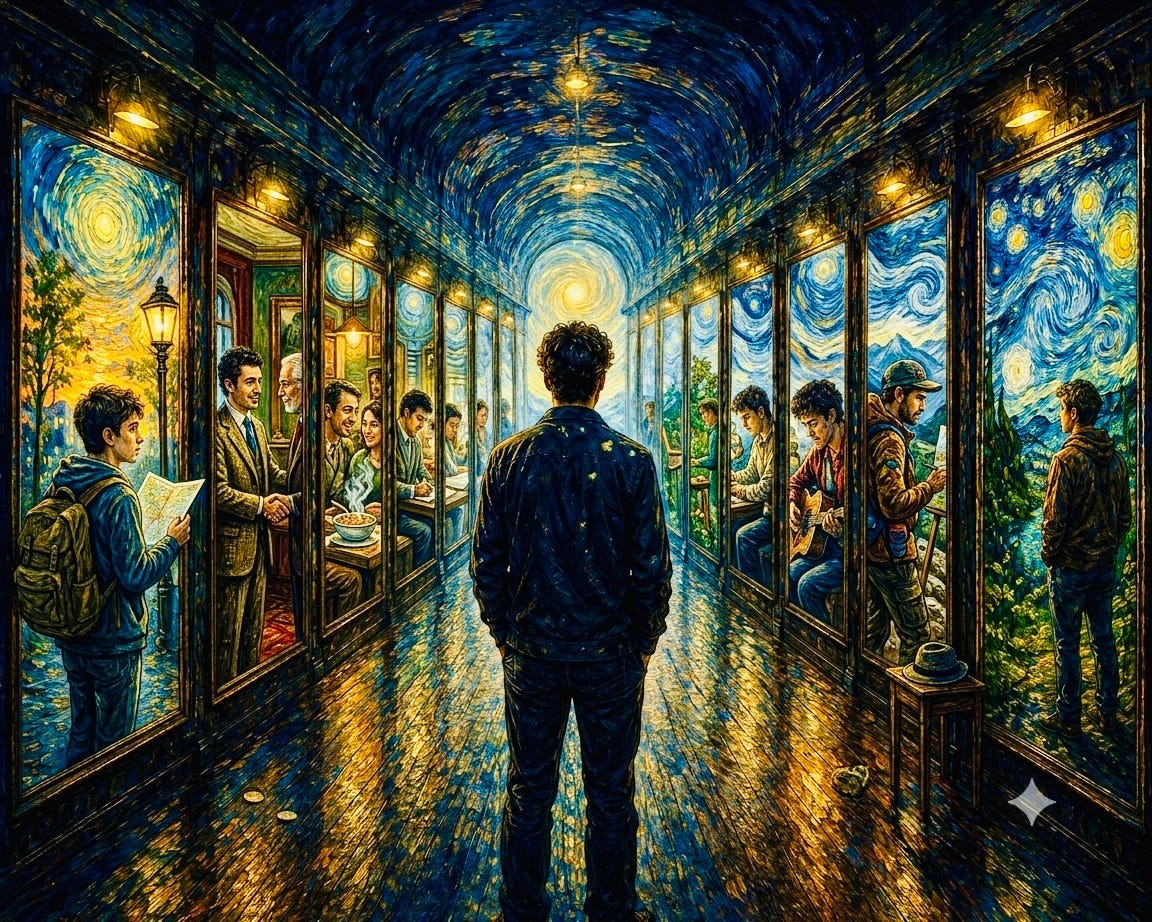
What this points toward isn’t passion, or purpose in the usual sense. It’s something closer to alignment. Alignment between what we naturally are, who we’ve become, the World we’re standing in, and what we choose to do within it. When those begin to line up, the feeling appears. You don’t create it. You uncover it. There seems to be something within us that recognises alignment long before our thoughts manage to explain it. Call that Being. Not in some mystical or metaphysical sense, but simply your natural self—in the flesh, in the present—living in alignment with what it already is.
You’ve probably felt the opposite too. Working a soul-sucking job. Holding onto a toxic relationship. Surrounding yourself with people who leave you drained. Misalignment has a way of making itself impossible to ignore. It appears as exhaustion, resentment, anxiety, boredom, or that strange emptiness we struggle to name.
The World screams at us through the mirrors it holds up.
But we often mistake the reflection for the thing itself.
Take something as ordinary as saying, “I hate my job.” Most of us stop there. The job becomes the problem. Leave the job, and the problem disappears. Sometimes that’s true. Some workplaces really are unhealthy. Some relationships really are destructive. But even then, it’s worth asking another question: What, exactly, is this situation revealing about me?
Maybe it’s fear. Maybe it’s conformity or people-pleasing. They didn’t necessarily begin with the job. The job simply gave these reflections somewhere to become visible. Leaving may remove one reflection. But unless we’ve understood what the reflection was showing us, we often find ourselves staring into a remarkably similar mirror somewhere else.
The mirror also reveals what we’re capable of loving. The people who make us feel expansive. The work that absorbs us so completely that time seems to disappear. The conversations that leave us more alive than when they began. These, too, are reflections.
Perhaps this feeling of aliveness has always been there; not waiting to be generated, but waiting to be uncovered. It becomes difficult to hear beneath the noise of expectations, obligations, identities, and habits we’ve accumulated over time. And when that noise begins to quieten, the reflection clears. For a moment, we recognize ourselves.
But first, we have to be willing to look. Most of us, barring the fortunate few who’ve already found this clarity, don’t like what the mirror shows us—so we try to change it, explain it away, or run from it. We justify. We reach for the bottle. We build walls just sturdy enough to keep the reflection out, and move on.
I invite you to join me on this journey. And I invite you to take the first step: stare into the reflection, and look at what you see. Don’t run from it. Don’t try to explain it. Don’t try to justify it.
Just look.
Then see what starts to happen…
Thank you for the read.
Brilliant!